


 Premium





 Register for Free to get streaming real-time quotes, interactive charts, live options flow, and more.


The scaling of IC technology plays a vital role in understanding the performance grade. As the fabrication plants constantly race to develop smaller nanometer nodes, attempting to pack more circuits on die, lowering power and increase performance, physics introduces more complex challenges. However, this technology scaling has brought numerous intensified, new challenges such as elevated power densities, high ratio of leakage current, and heat distribution. The impact of on-die temperature discrepancy is the other emerging critical complexity because of technology scaling. It is noteworthy to know about the previous second-order and first-order effects to understand the Electro-Thermal Aware Design Environment methodology.
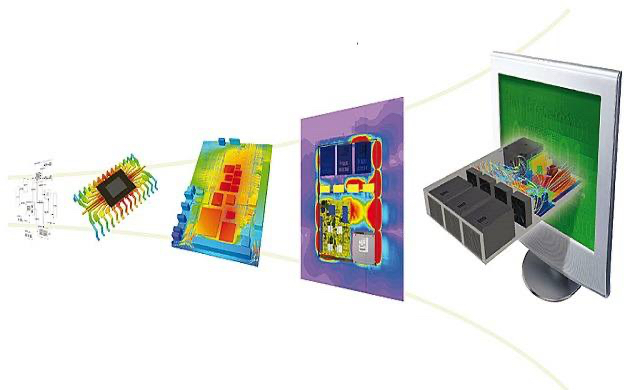
These effects are a significant reason for developing Electro-Thermal analysis and simulation tools. There is an urgent need for innovative EDA technologies to keep microchips at optimal operating temperature to achieve a continuous, high performance and reliability. Power distribution strategies and general design techniques are driven by specific chip temperatures. Solving temperature concerns in the development community because of the size and intricacy of this thermal relationship is necessary.The package’s materials, dimensions, and properties, including the surrounding environment, all affect the temperature measurements inside a chip. The increased power density in modern designs causes devices as interconnections to produce heat, increasing temperature differences across the chip. Temperature can fluctuate in integrated circuits by up to 50 C° across the chip and much more in high frequencies ones.
Heat and thermal gradients must now be taken into consideration by IC’s designers particularly for smaller nodes, analog, RF, and MIXED types. The many problems brought on by thermal gradients and subsequent impacts on the electrical properties of digital and analog designs can be observed in tech gadgets. In order to analyze and simulate the microchip’s electrical performance, modern design techniques assume a stable temperature throughout the chip. Various temperature extremes scenarios are analyzed and simulated according to sub-circuits and components operational modes to construct early solutions and counter measures. In this way designers can predict excessive heat regions, eliminate them and eliminate excessive heat risks, early during the design phase.
Temperature effects on electrical characteristics
The sub-threshold circuit has dramatically increased due to technology scaling with design advancements in power saving. Leakage power eventually started to take over as one of the primary chip’s bottlenecks for performance and reliability factors. Power loss and temperature have a significant inverse relationship. Combining precise temperature computation, circuit characterization, and analysis of a circuit states can improve the accuracy of power loss estimation. The assessment of leakage, circuit’s modes, operation frequency, and physical layout characteristics, is crucial for an efficient power management and optimal thermal design. Any temperature change ultimately makes a difference in the device’s leakage, power, and operation’s efficiency. In order to provide an accurate Electro-Thermal analysis, the system must simultaneously evaluate the microchip zone’s temperature taking into account various electrical factors, among them are current/power distribution, voltage drops, frequencies, timing, and operation modes.
Dr. Danny Rittman
Click here to learn more: https://gbtti.com/investor-relations/